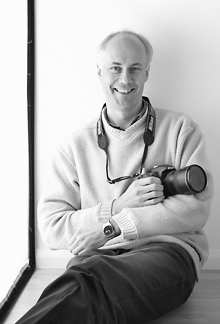
Bloke with a Camera - the interview
|
How did you get to be 'Bloke with a Camera'? It all started as a bit of fun really. Having used film for years, in 2003 I bought a little digital compact - just as a toy - and was amazed at what it could do. After a few months I'd taken some images I rather liked, and got them accepted for exhibition in local libraries. I spent loads on printing, frames and mounting card, and ended up with 40 nice exhibition prints on show. Did you sell any? Nope! People liked them but nobody actually wanted to buy one. So I was simply decorating the County's libraries free of charge and at my own expense... However, I was so inspired by the possibilities of digital imaging that I promptly swapped my film SLR for a DSLR, and that's where the story begins. How did you get from there to weddings? Thanks to a mention on a wedding forum, I got an e-mail from a couple looking for a photographer. They came round for a chat and we were getting on very well, and then the chap said 'Have you got any samples of wedding photos we can see?'. I had to reply 'No, but this is me, and this the kit I plan to do it with, and you've seen some of my other stuff - how about it?' And Richard and Natalie trusted me and booked me. From that first wedding, I got good photographs I could use to help get the second one. And it just snowballed from there! |
|
|
|
Why are you different from other wedding photographers? Two main things. Firstly, I work by being me - by being natural. I have a reportage style which you can see on this site - essentially I don't set things up artificially. If people like what they see on this website, they get in touch and away we go. We meet up, talk it over and the couple get what they really want. Normally they come to me because they don't want formality, or stuffiness, or being herded about and told to say cheese. Where's the fun and originality in that? I prefer people to smile because they want to! Secondly, there are no fixed packages - every wedding is different so I'm not a dreary old sausage machine. People can buy as much or as little photography as they want, and just as important, I don't make them buy prints or albums - they're welcome to have all the photographs on disk. Sometimes, when I'm doing a location visit, bemused officials say 'Oh, but none of the other photographers do that!'. This inspires me, because it reminds me I'm always looking to get better results for my customers than the average 'tog', who does the same old shots from the same old places, and gets the same old predictable boring results. In fact, thinking about it, I don't really photograph weddings, I photograph people. The fact they're getting married is a bonus. People are endlessly fascinating and it's the combination of people and what they do that make the day and the moments to capture. You don't do prints or albums? My customers are intelligent. They know you can buy prints for pennies online, so why pay a photographer £10+ each for them? It's barmy, especially in these times of recession. I'd rather they put the money towards their honeymoon or a new kitchen. So the 'Bloke concept' is to charge for my time and skill on the day, put all the photographs on a disk and then let them do what they want with it. It suits me, it suits the customers and it sets me apart from the herd. £1800+ for an album with 50 prints? You're having a giraffe! So how much do you charge? Typically, from £800 to £1200 depending on the amount of work and time needed. Every wedding is different and people want different things, so each job is planned and quoted individually. Remember that this also includes around three days of digital processing, so the rate is really for four days, not just one. Yes, you'll find photographers who seem cheaper, but they'll claw it all back and more afterwards when you want prints. My way, you can copy the disk, make your own prints and photobooks, upload to the internet and e-mail them around the world for no extra charge. For example, if you want to send every image to every guest (let's say 100 guests and 500 images) at £10 a print, that's... well, it's not going to work is it! So you really do save massively - check out the Album page for more details. What's digital processing? To get the highest quality I shoot in a format called RAW. It's like a digital negative - it gives the best results but has to be processed in a computer to make an image you can see at home. Most photographers do this in batches to save time. I don't, because every image is different and so needs different treatment. I use Phase One's Capture One Pro, adjusting *every* image individually to get the optimal exposure, white balance and shadow detail. High contrast scenes are double-processed and composited using layer masks in Photoshop. As you can imagine it takes considerable time and concentration, but it's worth it because it gives the best results. Sometimes customers ask for the original RAW files as well as JPGs because they're keen snappers and want to experiment. This gets most togs running scared, but not me. If you want the RAWs, you can have them for free. Do you use Photoshop? This question crops up quite a lot. I use Photoshop to composite high contrast images, but not to make cliché wedding effects. If I make an image black and white, it's because it looks good, not because I'm trying to patch up a bad photograph! For a detailed estimate, or if you have any questions, just mail me with as much information about the day as possible - places, times etc - and say what you'd like :-)
|
||
|
|
||
|
|
||